Vektor Core 2
ArduPilot-compatible controller for unmanned vehicles and robotics, built around the STM32H743.
- Processor
- 480 MHz
- PWM outputs
- 16 channels
- Board size
- 85 × 56 mm
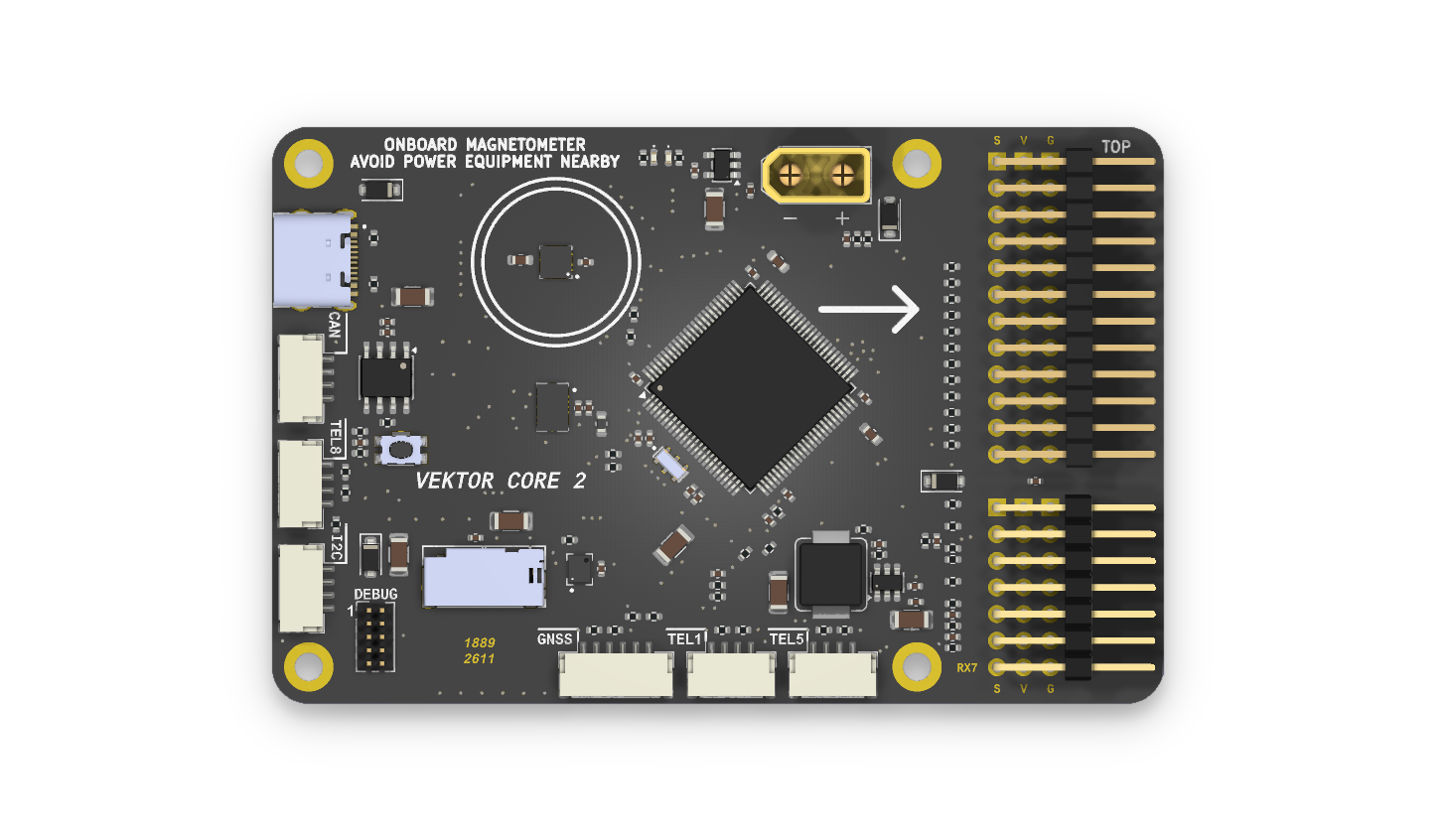
The board provides 16 PWM outputs, receiver and telemetry interfaces, DroneCAN, and microSD logging. A companion computer can be connected over MAVLink.
Connector pinout
Use this top view to locate each connector on the board. CH1–CH16 are the PWM outputs, RPM1/RPM2 are the speed sensor inputs, and RCIN is the serial receiver input. Open the image to read the pin labels at full size.
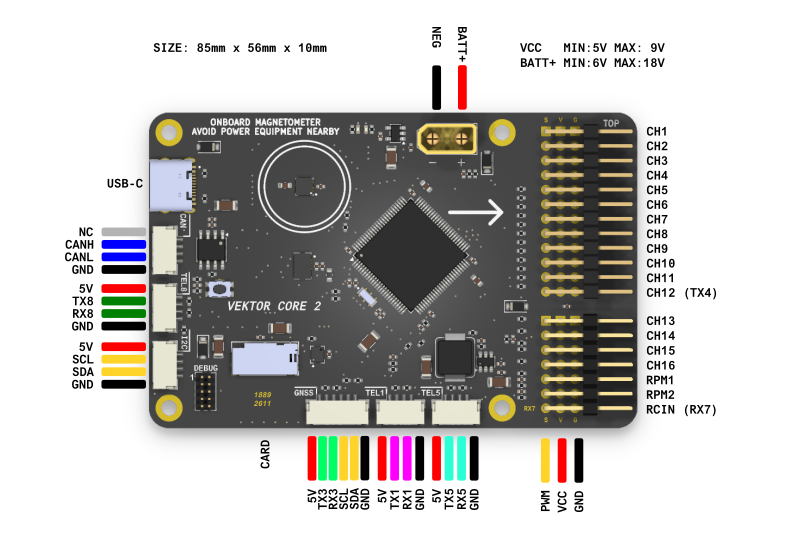
See Ports and pinout for connector pin order, signal direction, and PWM timer groups. The BATT+ range printed on the diagram differs from the battery sensing specifications. Confirm the connector and voltage rating for your board revision before wiring.
The board is shipped without firmware. Install and configure firmware for the intended vehicle before operation. Installation and configuration require appropriate technical expertise; software installation and configuration are the user's responsibility. See Firmware Downloads for DFU instructions.
Technical specifications
Processing and sensors
| Component | Specification |
|---|---|
| Processor | STM32H743, ARM Cortex-M7 at 480 MHz |
| IMU | Bosch Sensortec BMI088 |
| Barometer | Infineon DPS368 (optional) |
| Magnetometer | Memsic MMC5983MA |
Interfaces
| Interface | Specification |
|---|---|
| PWM outputs | 16 channels on JR connectors; DShot supported on all channels |
| RC input | Dedicated JR port for SBUS, IBUS, SUMD, and other legacy serial protocols |
| RPM inputs | 2 ports for Hall sensors |
| Telemetry | 3 ports; supports ELRS and other telemetry devices |
| CAN | CAN 2.0, up to 1 Mbit/s; DroneCANv0 |
| Storage | MicroSD slot for mission data and logs |
| USB | USB-C for programming and configuration |
| Expansion | Underside ESP32 pads for an ESP32-C6 module; USART2, 3.3 V logic, maximum 500 mA draw |
| Companion computer | MAVLink connection to a device such as a Raspberry Pi or Nvidia Jetson |
Power
| Feature | Specification |
|---|---|
| Supply input | 5-9 V external BEC through the PWM pin header; size the BEC for the board and connected devices |
| Current consumption | Approximately 200 mA at idle; 1 A or more under load |
| Peripheral supply | Onboard 5 V, 2 A switching regulator for devices such as GPS, receivers, and telemetry modules |
| Battery voltage sensing | Dedicated input with internal divider; maximum 26 V |
| Power monitoring | Voltage sensing for the servo rail, 5 V peripheral supply, 3.3 V MCU supply, CAN power, and battery |
Use an external 5-9 V BEC with sufficient current capacity for the board and connected devices. At a 5 V supply, the GPS and RX ports receive approximately 4.5 V, which may be insufficient for some peripherals. The product FAQ recommends 6-9 V and states that operation outside that range is not covered under warranty.
Physical and electrical characteristics
| Feature | Specification |
|---|---|
| Dimensions | 85 x 56 mm; Raspberry Pi form factor |
| Connectors | JST-GH connectors and gold-plated contacts |
| Protection | EMI-filtered ports; automotive-grade ESD protection up to 15 kV |
| Components | Samsung Electro-Mechanics resistors and Murata capacitors |
| Published service lifetime | 500 hours, depending on environment and usage |
| Published memory lifetime | 10,000 write cycles |
| Compliance | RoHS compliant |
Firmware compatibility
Vektor Core 2 can run standard ArduPilot Plane, Copter, Rover, and Sub firmware builds for the board. Plane and Copter require a barometer. Use the optional onboard DPS368 or a supported external I²C barometer.
Installation and operating environment
Install the board and configure it for the intended application. Humidity, salt exposure, temperature extremes, mechanical stress, incorrect installation, and operation outside the specified parameters can reduce service life. For saltwater environments, the manufacturer recommends treating the board with WET.PROTECT before use.
The board is supplied as a component. The system integrator or OEM is responsible for compliance of the completed system, including WEEE and EMC requirements. Hardware warranty and support do not cover software-related issues. See the product page for warranty terms and available variants.